
Pilots need perfect vision to ensure safety and performance in the cockpit. Dr. Peterson in Reno, NV, offers personalized eye care for pilots, addressing unique challenges like high-altitude UV exposure, dry eyes, and FAA visual standards. Paired with Flying Eyes Eyewear – designed specifically for aviation – pilots get tailored solutions for clear, comfortable vision during flights.
Key Highlights:
- Dr. Peterson’s Concierge Eye Care:
- Membership plans starting at $39/month or $429/year.
- 24/7 access to care, unlimited exams, and discounts on eyewear.
- FAA-compliant exams tailored to aviation needs, including cockpit-specific lens prescriptions, color vision testing, and dry eye management.
- Flying Eyes Eyewear:
- Designed for use with headsets: ultra-thin temples prevent pressure points and noise leaks.
- UV400-protected, non-polarized lenses for cockpit display clarity.
- Lightweight, durable frames starting at $229.
Quick Comparison:
| Feature | Dr. Peterson’s Eye Care | Flying Eyes Eyewear |
|---|---|---|
| Focus | Comprehensive eye care for pilots | Aviation-specific eyewear |
| Pricing | From $39/month or $429/year | From $229 |
| Key Benefit | Tailored exams for FAA compliance | Comfortable fit with headsets |
| Unique Feature | 24/7 access, cockpit-specific care | Ultra-thin temples, UV400 lenses |
For pilots, this combination ensures sharp, reliable vision and comfort in demanding aviation environments.
FLYING EYES SUNGLASSES Review | Worth It? | Flight Training & Aviation #pilots
Dr. Peterson’s Concierge Eye Care for Pilots in Reno
Dr. Peterson’s Legacy Vision offers a unique concierge eye care service tailored specifically for pilots in Reno. This membership-based model focuses on delivering prompt, personalized care without the limitations often imposed by insurance. By eliminating delays caused by insurance approvals, pilots can quickly address vision concerns with direct access to expert care.
Located at 9120 Double Diamond Pkwy, Reno, NV 89521, Legacy Vision ensures pilots meet the stringent visual standards required for aviation. Dr. Peterson brings extensive experience in managing chronic eye conditions and collaborates with ophthalmologists for specialized treatments when necessary.
Pilots rely on impeccable vision to perform their duties safely. Whether it’s addressing age-related vision changes, managing conditions like glaucoma, or meeting FAA vision requirements, Dr. Peterson provides tailored care with a focus on each pilot’s unique needs.
Membership Plans and Pricing
Legacy Vision offers flexible membership options to suit every pilot’s needs. A 3% processing fee applies to all memberships, which include unlimited eye exams, visits, and discounts on eyewear and contact lenses.
- Monthly Membership: $39.00 per month, offering full access to eye care services and product discounts.
- Annual Membership: $429.00 per year, saving the equivalent of one month’s fee for those who prefer annual billing.
Special rates are available for pilots who are current patients of Preferred Family Medicine:
- Preferred Family Medicine Monthly Membership: $29.00 per month.
- Preferred Family Medicine Annual Membership: $319.00 per year.
For Medicare patients, the Medicare Patient Annual Preventative Care plan is available for $200.00 per year. This plan covers all non-Medicare services and includes discounts on eyewear and contact lenses. Additionally, family coverage is simplified: when both spouses or partners enroll, dependent children are included at no extra cost.
24/7 Access and Comprehensive Care
One of the standout features of Dr. Peterson’s concierge service is 24/7 access to care. Whether through tele-optometry or in-person consultations, pilots can reach Legacy Vision any time of day, any day of the year. This ensures immediate attention for urgent vision issues without the delays caused by insurance.
Members receive comprehensive care for conditions like dry eye, conjunctivitis, and chronic ocular problems. They also enjoy discounts on eyewear, ensuring access to the specialized vision solutions critical for the high demands of aviation.
Custom Vision Solutions for Pilots
Aviation calls for vision care that goes beyond the ordinary. Dr. Peterson recognizes that pilots face distinct visual challenges, requiring specialized attention and tailored solutions. Her unique approach to eye exams is specifically designed to address these aviation-specific needs.
Flying places extraordinary demands on vision that most people never experience. Pilots must maintain sharp eyesight at various distances – whether it’s reading an instrument panel up close or spotting other aircraft miles away. Dr. Peterson’s exams are crafted to address these challenges. She evaluates how altitude impacts vision, tests color perception critical for interpreting aviation lights and instruments, and ensures eyes can quickly adjust between bright sunlight and the dim lighting inside a cockpit.
Comprehensive Eye Exams for Pilots
Dr. Peterson’s pilot-focused eye exams are designed to not only meet but exceed FAA vision standards, addressing the practical demands of flying. The FAA sets specific vision requirements depending on the class of medical certificate. For First and Second Class Medical Certificates, pilots must have 20/20 or better distant vision in each eye (with or without correction) and 20/40 near vision at 16 inches. Pilots aged 50 and older must also meet intermediate vision standards of 20/40 at 32 inches. For Third Class Medical Certificates, the requirement is 20/40 or better for both near and distant vision.
Dr. Peterson goes a step further. She measures the exact distance from a pilot’s eyes to the aircraft’s instrument panel to prescribe lenses optimized for cockpit use. Color vision testing is another critical component, as distinguishing navigation lights, warning signals, and chart symbols is essential for safety. Advanced diagnostics can even identify subtle color vision issues that might compromise flight performance.
Her exams also include a detailed dry eye assessment. The low-humidity environment of aircraft cabins, combined with reduced blinking while focusing on instruments, can lead to discomfort and blurred vision. Additionally, she evaluates how well eyes adapt to changes in lighting – from bright sunlight to dim cockpit conditions – and tests night vision, which is vital for flying at dawn, dusk, or nighttime.
Preventive and Long-Term Eye Care
Maintaining optimal vision isn’t just about the initial exam – it’s about ongoing care. Dr. Peterson emphasizes a proactive approach to eye health, crucial for pilots who want to sustain their vision throughout their careers.
Regular checkups are key. Dr. Peterson advises pilots to undergo thorough eye exams at least every six months, allowing early detection of any changes that could affect FAA compliance or cockpit performance.
UV protection is another priority. Pilots are exposed to significantly higher levels of UV radiation at high altitudes. For instance, spending an hour flying at 30,000 feet exposes a pilot to the same amount of UV radiation as 20 minutes in a tanning bed. Dr. Peterson recommends aviation-specific sunglasses that block 100% of UV light and provide optimal protection.
To combat dry eyes and digital strain in low-humidity cabins, she advises staying hydrated and following the 20-20-20 rule: every 20 minutes, look at something 20 feet away for 20 seconds.
Long-term vision health also includes nutritional support. Dr. Peterson may suggest supplements like MacuHealth, which contains Lutein, Zeaxanthin, and Meso-Zeaxanthin. These nutrients support macular health and help protect against UV damage and blue light from cockpit displays.
"What’s good for the heart, is good for the brain, is good for your eyes." – Dr. Alex Ionides, Consultant Ophthalmic Surgeon at Moorfields Eye Hospital
Practical vision correction solutions are also addressed. Pilots who need corrective lenses are reminded of the FAA’s requirement to wear them during flights. For contact lens wearers, Dr. Peterson recommends always carrying a backup pair of glasses. In some cases, she advises using glasses instead of contacts to minimize dryness and discomfort in the cabin environment.
For pilots dealing with presbyopia, multifocal contact lenses approved by the FAA offer a new option. These lenses correct for distance in the center while addressing near vision in the periphery. Dr. Peterson stays updated on these advancements and works with pilots to determine the best vision correction options for their specific needs and flying conditions.
sbb-itb-cf40f75
Flying Eyes Eyewear: Designed for Pilots
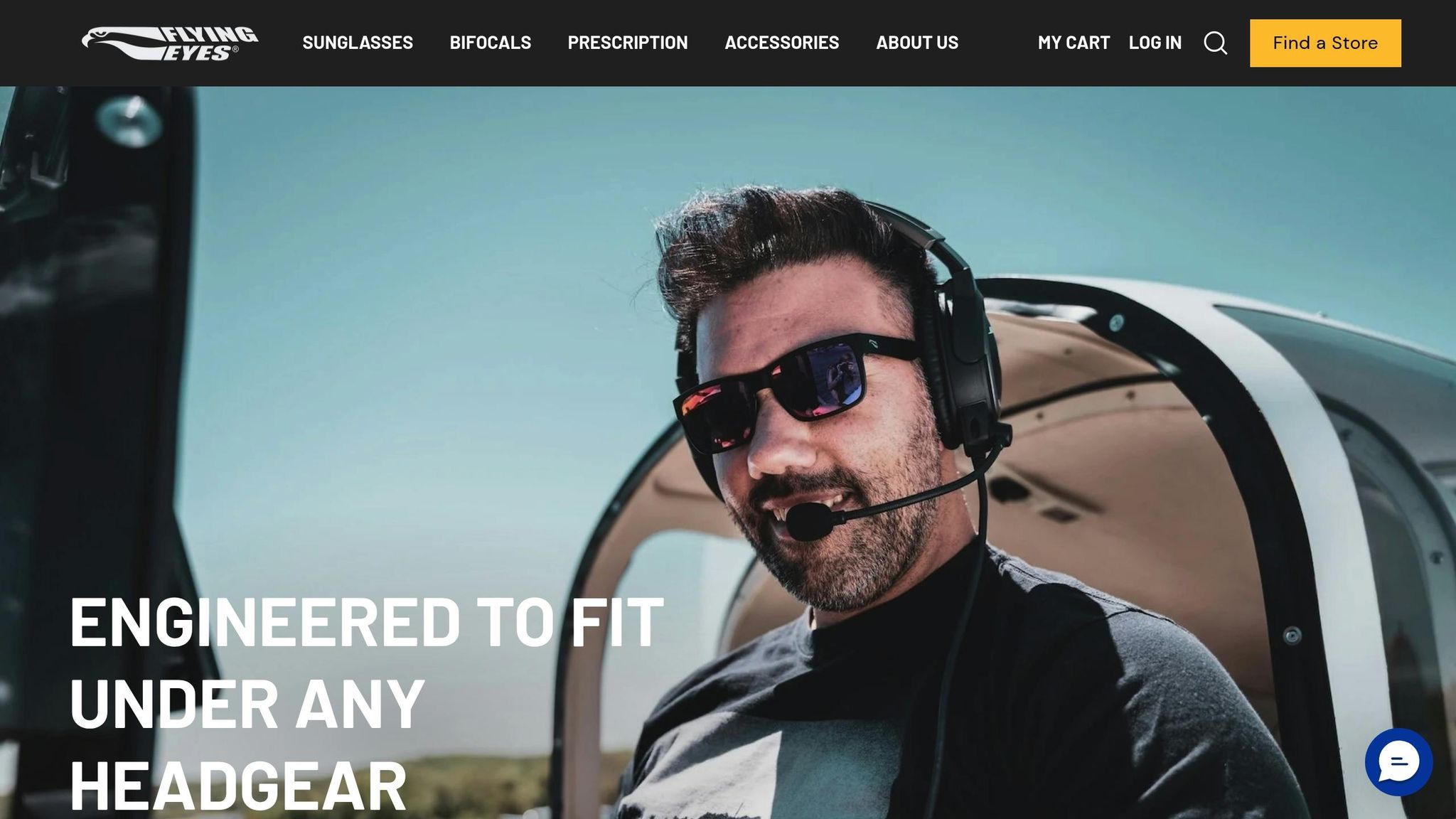
Flying Eyes Eyewear is crafted specifically for aviation, working hand-in-hand with Dr. Peterson’s tailored vision solutions for pilots.
Dean Siracusa, the founder of Flying Eyes Optics, explains the motivation behind the design:
"We consistently hear from pilots, motorcyclists, and others that standard prescription glasses dig into the side of their heads or break seals on their noise-canceling headsets. It can cause headaches, ear pain, and safety issues."
This discomfort is a common problem, affecting over 30% of individuals who frequently wear helmets or noise-canceling headsets. For pilots, who often endure long hours in the cockpit, poorly designed eyewear can lead to distractions and even compromise performance.
Flying Eyes Eyewear addresses these challenges by undergoing rigorous testing in demanding conditions – from high-altitude cockpits to highways at speeds over 80 mph, and even tactical environments. This ensures the eyewear delivers reliable performance when it’s needed most.
Key Features and Advantages of Flying Eyes Eyewear
Flying Eyes frames are made with Resilamide™, a material originally developed for aerospace applications. This polymer offers exceptional durability, featherlight comfort, and flexibility, making it ideal for extended wear under headsets.
The ultra-thin, flexible temples are a standout feature. They eliminate the pressure points that typically occur when wearing glasses under aviation headsets and help maintain the integrity of noise-canceling systems by preventing noise leaks. This design is essential for clear communication and hearing protection in noisy cockpit environments.
Another critical component is the shatterproof, UV400-protected lenses, which guard against the heightened UV exposure pilots face at high altitudes. Long-term eye health is a priority, and these lenses provide the necessary protection.
Flying Eyes also offers non-polarized lenses as the standard option for pilots. Polarized lenses can interfere with the visibility of LCD and LED flight instruments, making non-polarized lenses a safer choice. As Dean Siracusa advises:
"Ask your patients if they wear helmets, use headsets, or rely on digital screens. That one question can help opticians avoid recommending the wrong lens, and steer the conversation toward safer, smarter alternatives."
For those needing prescription eyewear, Flying Eyes offers a full range of options, including progressives and bifocals. Dr. Peterson often recommends Trivex lenses for their clarity and impact resistance, ensuring pilots get the best visual experience.
Additionally, the eyewear incorporates Setex nose pad technology, which provides a grip over 250% stronger than standard nose pads. This feature ensures glasses stay securely in place, even during long flights or in challenging conditions.
Flying Eyes has been a trusted name in aviation for over a decade. Aviation Consumer, a respected publication, has endorsed the brand, stating:
"Aside from a well-built, well-designed and versatile product, it’s refreshing that the glasses are backed with some of the best product support in the industry."
Flying Eyes Eyewear Features Comparison
Below is a quick overview of the features that make Flying Eyes a top choice for pilots:
| Feature | Specification | Aviation Benefit |
|---|---|---|
| Temple Design | Ultra-thin Resilamide™ material | Eliminates headset pressure points |
| UV Protection | 100% UV400 protection | Shields against high-altitude UV rays |
| Lens Options | Non-polarized standard | Ensures instrument display readability |
| Weight | Lightweight construction | Reduces fatigue on long flights |
| Headset Compatibility | Seamless fit design | Prevents noise leaks and maintains seal integrity |
| Durability | Shatterproof lenses | Withstands high-vibration environments |
| Prescription Options | Full range available | Meets all vision correction needs |
| Nose Pad Technology | Enhanced Setex grip | Stays secure during extended wear |
| Price Range | Starting at $229 | Professional-grade eyewear investment |
| Customer Rating | 4.3/5 overall performance | Proven reliability in aviation settings |
Flying Eyes also offers try-on kits for $30, allowing pilots to test the fit and compatibility with their headsets before committing to a purchase. For added peace of mind, the company provides loss protection for $35 on non-prescription glasses, recognizing the active and demanding environments in which their eyewear is often used.
One of their standout models, the Golden Eagle Sport Sunglasses, exemplifies the brand’s dedication to quality. It has received ratings of 4.3/5 for performance, 4.3/5 for durability, 4.5/5 for reliability, and 4.8/5 for ease of use. These scores reflect real-world feedback from pilots who depend on their eyewear for both comfort and safety.
Dr. Peterson collaborates closely with Flying Eyes to ensure pilots in Reno receive eyewear that not only meets their vision needs but also integrates seamlessly with their aviation gear and routines.
Practical Tips for Pilot Eye Health
Building on Dr. Peterson’s specialized approach to pilot eye care, these tips are designed to help protect your vision during flight. Pilots face unique challenges, including high-altitude UV exposure, intense cockpit glare, and the demands of precision vision, making proactive care essential.
Protection from UV and Glare
Understanding UV Exposure at High Altitudes
UV radiation increases by about 4% with every 1,000 feet of elevation. To put it into perspective, spending an hour at 30,000 feet is comparable to 20 minutes in a tanning bed. This heightened exposure explains why pilots are twice as likely to develop skin cancer compared to the general population.
Key Strategies for UV Protection
Choose sunglasses that block 99–100% of UVA and UVB rays. Opt for lenses in neutral green or gray shades, as they maintain color accuracy . While brown lenses can enhance contrast, they may slightly distort colors, which could be problematic for reading instruments.
Dealing with Glare in High-Altitude Environments
Reno’s high desert environment, with its bright sunlight and altitude, presents unique glare challenges. On hazy or smoggy days, yellow or brown lenses can improve contrast, but avoid them when precise color recognition is necessary for cockpit tasks.
Enhancing Cockpit Window Protection
Consider FAA-approved solutions to reduce glare and UV exposure in the cockpit. Options include Jet Shades (ranging from $429.00 to $2,499.00), replacement windows, or removable sun-blocking panels .
Kevin J. Duggan, President of Jet Shades, highlights their importance:
"Sun protection is a critical issue for pilots, but it should never come at the expense of performance. Our Generation 2 Jet Shades for the Cirrus G6 and G7 are designed to provide superior comfort while preserving visibility and protecting the aircraft. And with FAA approval, pilots can trust that these shades meet the necessary safety and quality standards to be a valuable addition to their aircraft."
By combining these UV and glare management strategies with tailored vision correction, you can maintain clear and comfortable vision in the cockpit.
Vision Correction in the Cockpit
Protecting your eyes is only part of the equation – ensuring your vision is optimized for cockpit tasks is equally important.
Prescription Eyewear Tips
Measure the distance between your face and the instrument panel to ensure your lenses are tailored for cockpit use.
Lens Considerations for Pilots
Avoid polarized lenses in the cockpit. While they reduce glare, they can interfere with electronic displays and make it harder to spot other aircraft.
Contact Lens Tips
If dry cabin air causes discomfort with soft contact lenses, consider switching to scleral lenses. These larger lenses retain moisture better and provide more stable vision during long flights.
Reducing Eye Strain and Night Vision Care
Electronic cockpit displays can cause significant eye strain. Use the 20-20-20 rule: every 20 minutes, look at something 20 feet away for 20 seconds . For night flights, dim cockpit lighting to help preserve your natural night vision.
Routine Eye Exams
Schedule comprehensive eye exams more frequently than required by the FAA to catch potential issues early.
Nutrition and Lifestyle for Eye Health
Support your vision with a nutrient-rich diet. Include foods high in omega-3 fatty acids, zinc, vitamins A, C, and E, and lutein. Think oily fish, leafy greens, quality proteins, and citrus fruits. Also, avoid smoking, which can lead to severe eye conditions and even blindness .
Hydration and Dry Eye Relief
Cabin air can be very drying, so stay hydrated and use artificial tears to keep your eyes comfortable.
Conclusion: Better Pilot Vision with Dr. Peterson and Flying Eyes Eyewear
For pilots in Reno, Dr. Peterson’s concierge optometry services paired with Flying Eyes Eyewear creates a tailored solution for the unique visual demands of aviation. This partnership combines personalized care with specialized equipment designed specifically for the cockpit environment.
Dr. Peterson’s Legacy Vision membership model simplifies access to top-tier eye care. With 24/7 availability, unlimited office visits, and affordable monthly plans, pilots can prioritize their vision health without worrying about scheduling conflicts or dealing with insurance hassles. This streamlined model ensures pilots receive the care they need, when they need it.
"As a member, you’ll enjoy the utmost in personalized, efficient, and expert eye care." – Legacy Vision
Flying Eyes Eyewear complements this care with aviation-focused eyewear. Their Resilamide™ temples are designed to eliminate pressure points under headsets while preserving the noise seal – an essential feature for clear communication in the cockpit.
The importance of these solutions becomes even clearer when considering the challenges pilots face at altitude. UV radiation increases by 4% for every 1,000 feet of elevation, making effective eye protection critical for both immediate performance and long-term eye health.
Dr. Peterson’s approach goes beyond meeting basic FAA medical requirements. Using advanced technology, he monitors long-term vision health, addressing challenges like high-altitude UV exposure and ensuring cockpit readability. Paired with Flying Eyes’ purpose-built eyewear, this proactive care equips pilots with the clarity and comfort needed for safe and effective flight operations.
Whether it’s battling Reno’s intense desert glare or meeting the precise visual demands of instrument flying, this combination of personalized optometry care and aviation-specific eyewear supports pilots in maintaining peak visual performance throughout their careers. Together, these solutions help pilots achieve the clarity and confidence needed for every flight.
FAQs
How does Dr. Peterson’s concierge eye care service uniquely support pilots’ vision needs?
Dr. Peterson’s concierge eye care service caters directly to the unique needs and tight schedules of pilots. With 24/7 availability and flexible appointment options, she makes it easy for pilots to receive top-notch care without interfering with their demanding flight routines.
Her tailored approach focuses on providing individualized solutions that not only support eye health but also optimize vision performance – ensuring pilots have the sharpness and accuracy critical for aviation safety and success.
What makes Flying Eyes Eyewear ideal for pilots using aviation headsets?
Flying Eyes Eyewear features ultra-thin, flexible Resilamide™ temples, specifically crafted to fit comfortably beneath aviation headsets and helmets. These lightweight temples minimize pressure on the sides of your head and avoid disrupting headset seals, ensuring a secure fit without sacrificing sound quality or comfort.
Built for durability and designed to handle the rigors of aviation, these frames are ideal for long flights and the everyday demands pilots face. Thanks to their thoughtful design, Flying Eyes Eyewear helps aviation professionals stay comfortable and focused throughout their journeys.
Why is UV protection essential for pilots, and how do Dr. Peterson’s services and Flying Eyes Eyewear help?
Flying at high altitudes exposes pilots to stronger ultraviolet (UV) radiation, making UV protection a crucial part of their safety routine. Prolonged exposure to these intense rays can increase the risk of cataracts and other long-term vision problems. Adding to the concern, aircraft windscreens don’t fully block UV rays, which means relying on proper eye protection is essential.
Dr. Peterson understands the unique challenges pilots face and provides customized eye care solutions to meet their needs. One standout option is Flying Eyes Eyewear – specialized glasses designed to protect against harmful UV rays while offering exceptional comfort and clear vision during flights. With Dr. Peterson’s guidance and the advanced features of Flying Eyes, pilots can safeguard their vision and stay focused on flying safely.
Related posts
- Why Northern Nevadans Are Choosing Dr. Jennifer Peterson for Superior Eye Care
- Enhancing Cockpit Readability: Vision Solutions for Pilots
- Navigating the Skies: How Pilots Can Maintain Optimal Vision With A Concierge Optometrist
- Pilot-Approved Eyewear and Vision Exams Now Available in Reno at Legacy Vision